
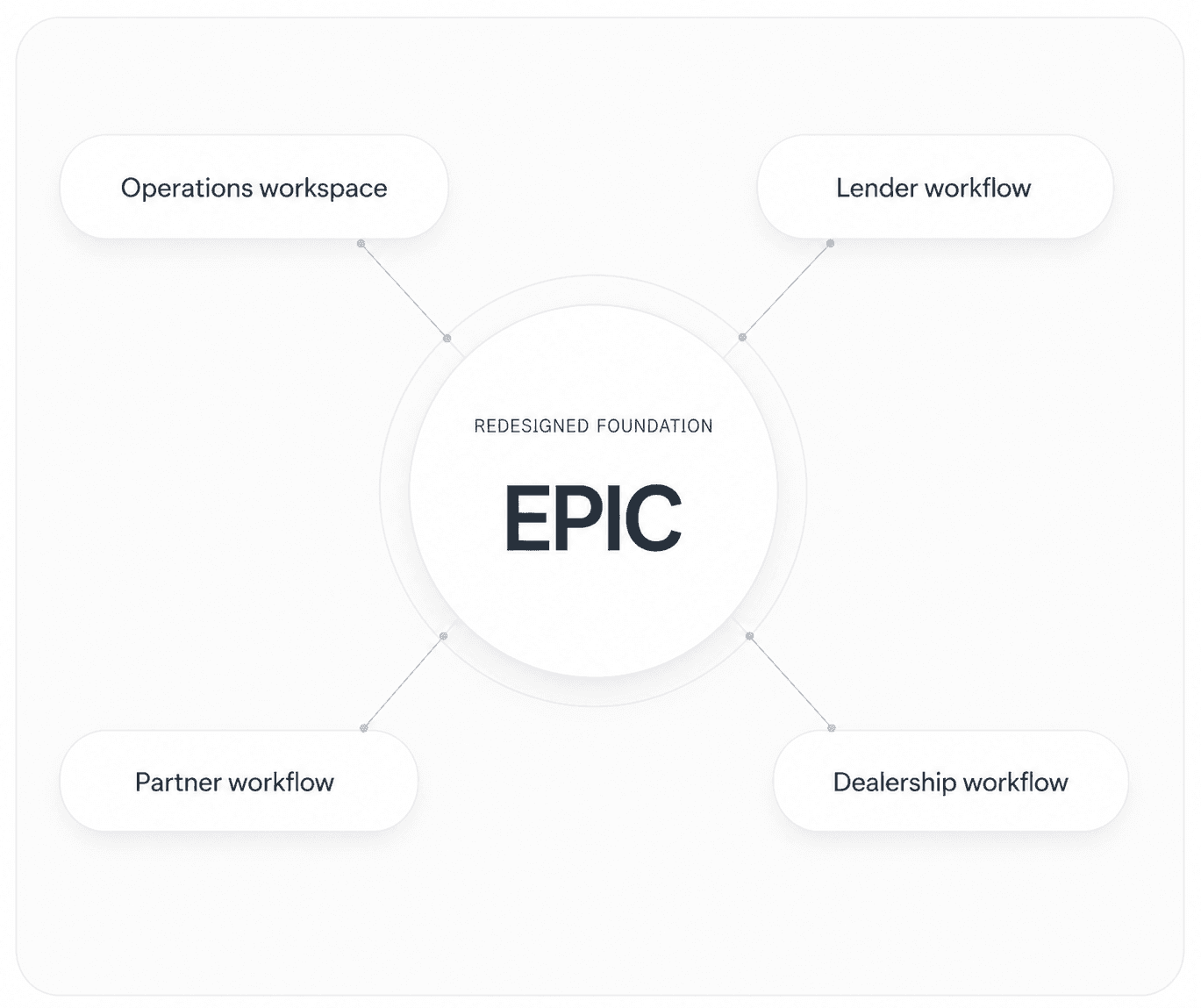
Project overview
A redesign of the system behind the screens.
Epic coordinates the work required when a dealership acquires a vehicle whose lien or title is still held by a financial institution. The main product I worked on was its internal operations admin, the workspace used to manage dealership and lender records, monitor transaction progress, and support the teams moving each case forward.
An established operations platform.
The existing admin already supported dealership, lender, and transaction workflows.
Strengthen the internal operations workspace.
Make complex records, actions, communication, and transaction progress easier for Epic's team to manage.
New structure, capabilities, and reusable patterns.
A clearer admin, end-to-end tracking, in-product calling, and new design-system components.
My contribution
Redesigning the core workspace behind Epic's operations.
I worked primarily on the Control Center, Epic's internal admin product. The redesign had to help operations teams manage dealership and lender records, understand the state of each vehicle transaction, contact the right people, and move work through a long chain of dependencies.
- Redesigned the internal admin and its core operational workflows
- Clarified how dealership, lender, and transaction records were managed
- Designed an in-product calling interface for operations teams
- Created an end-to-end transaction journey-tracking experience
- Added new reusable components to the existing design system
- Worked with product, engineering, and operations to resolve edge cases
Product context
The platform had to make a fragmented process feel coherent.
Vehicle payoff and title fulfilment involve different organizations, instructions, documents, payments, reviews, and status changes. Epic exists to bring that work into a connected operational experience.
The transaction Epic coordinates
- Vehicle received
- Payoff requested
- Payment confirmed
- Lien released
- Title fulfilled
- Transaction closed
The sequence looks linear on paper. In practice, different participants join at different points, instructions vary, documents require review, and important updates can happen outside the primary workflow.
Epic operations teams
Use the Control Center to manage organizations, monitor transaction progress, contact dealerships and lenders, and resolve operational work.
Primary redesign focusDealership teams
Provide vehicle and transaction information while moving an acquired vehicle through payoff and title fulfilment.
Transaction participantLenders
Provide the confirmations and documentation required to move payoff, lien, and title work forward.
Transaction participant- Complex relationships spread across connected experiences
- Operational detail competing with everyday transaction work
- Similar actions represented in different ways
- Growing variation requiring clearer product rules
- Status, ownership, and change needing greater visibility
- A clearer hierarchy for entities and information
- Focused workflows for each user group
- Additional detail shown only when relevant
- Shared interaction and status patterns
- Stronger visibility into actions and changes
Redesign approach
I worked from the operating model outward.
The redesign did not begin with visual polish. I first clarified the relationships, decisions, and handoffs the existing interface needed to support. That created a stronger foundation for redesigning individual screens and journeys.
Understand the existing experience
I reviewed the current product surfaces, recurring workflows, terminology, and operational requirements to locate ambiguity, repetition, and competing decisions.
Map the system behind the interface
I organized the people, organizations, transaction contexts, shared information, states, and dependencies shaping the experience.
Reframe the key journeys
I separated operational setup from everyday transaction work and introduced additional context only where it affected the next step.
Create connected product patterns
I aligned hierarchy, actions, status language, review behavior, and change history across internal, dealership, and partner experiences.
Resolve the details with the team
I worked with product, engineering, and operations to clarify requirements, account for edge cases, and shape an implementable redesign.
What I redesigned
Four interventions created a clearer product foundation.
The work moved beyond individual screens. Each intervention addressed a structural part of the existing platform while protecting everyday users from unnecessary operational detail.
Make complex operations manageable from one workspace.
I redesigned the Control Center around the records and actions Epic's team needed to manage dealerships, lenders, transactions, and operational exceptions.
Make every transaction milestone visible.
I designed a tracking experience that followed the vehicle journey through payoff, payment, lien release, title documentation, delivery, and completion.
Let operations contact either side without leaving the admin.
I designed an interface that allowed the internal team to initiate calls to dealerships or lenders directly from the operational context they were working in.
Extend the existing system for new operational patterns.
I added reusable components and interaction patterns to the existing design system so the new admin capabilities remained consistent with the wider product.
One connected product language
Consistency had to travel across every surface.
Design outcome
A clearer foundation for the product to grow.
The delivered redesign established a more coherent model for the platform's organizations, workflows, statuses, and handoffs. Because this was a confidential client engagement, this case study focuses on design outcomes rather than undisclosed business metrics.
A stronger admin foundation
The internal operations workspace gained a clearer structure for managing organizations, transaction activity, and operational work.
End-to-end journey visibility
Operations teams could follow important milestones across payoff, lien, title, documentation, and delivery work.
More direct communication
The calling experience created a direct path from the admin context to dealerships and lenders.
An extended design system
New reusable components and interaction patterns expanded the existing system while preserving product consistency.
06 · Reflection
Enterprise redesign starts with understanding the operating model.
Epic reinforced that redesigning an enterprise product is not simply a matter of simplifying every screen. The deeper work is deciding how the product should represent relationships, responsibilities, exceptions, and change.
By placing detailed controls with the people equipped to manage them, the redesigned experience could remain focused for users completing everyday transactions. This project strengthened how I approach enterprise UX: understand the system first, then design each interface around the decisions its user actually needs to make.
The goal was not to remove the complexity of the work. It was to make that complexity understandable and place it where it could be managed.