
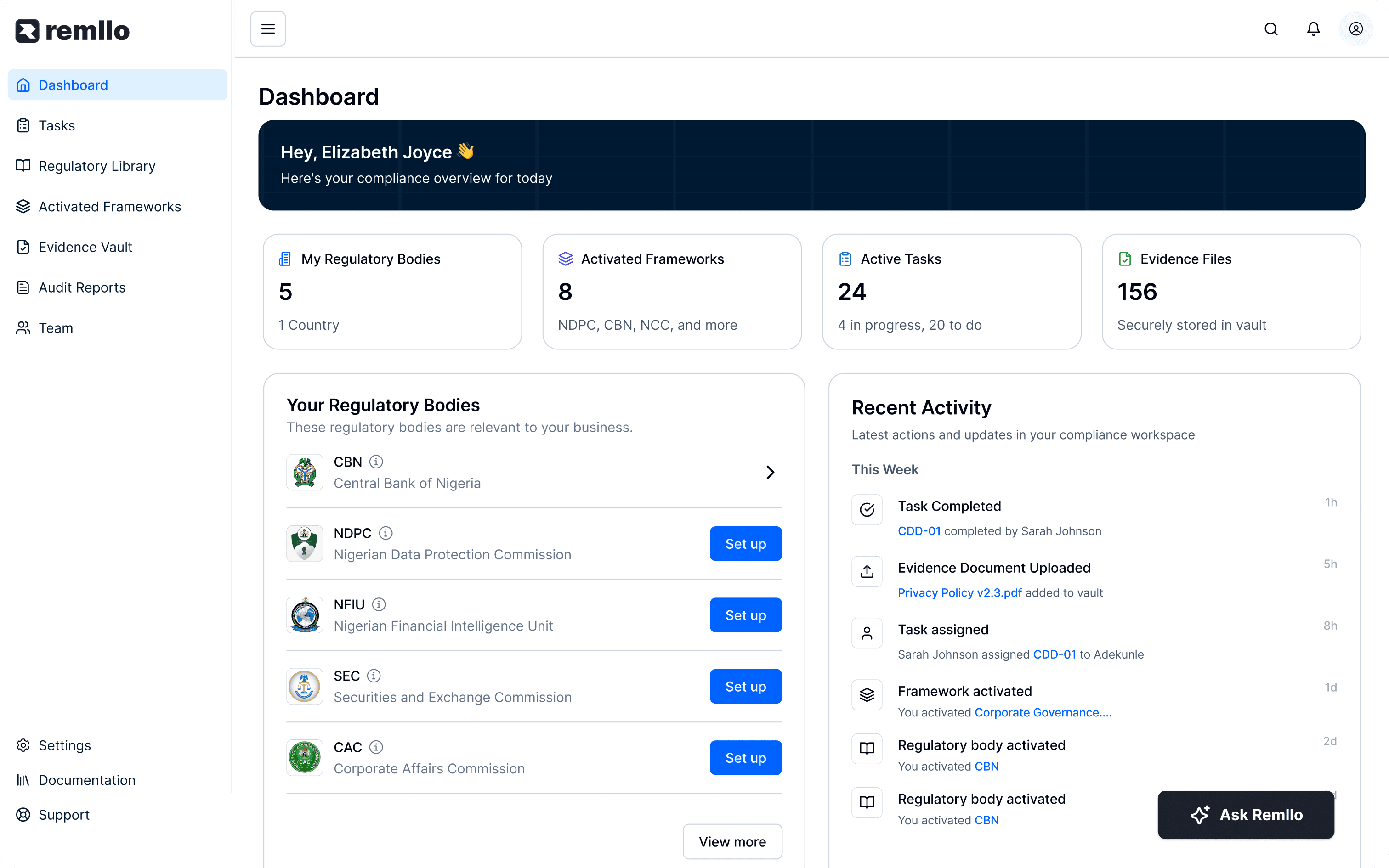
Project overview
A shared operating layer for continuous compliance.
Compliance work often moves between regulations, policies, spreadsheets, documents, reminders, and conversations. Remllo Compliance connects that work so teams can understand what applies, assign responsibility, collect evidence, and maintain a clearer record of progress.
My founder role
Shaping the product across strategy, design, and implementation.
I defined the product direction, mapped the core compliance workflows, designed the operating experience, explored how AI could assist without obscuring accountability, and contributed to implementation decisions. The work connected product strategy, UX, engineering, compliance operations, and company building.
Compliance within Remllo
The compliance layer within a connected risk and identity ecosystem.
Remllo is building AI-native risk, identity, and compliance infrastructure for regulated businesses. Compliance focuses on the internal operating work that helps teams stay organized, accountable, and prepared.
AI-native infrastructure for regulated businesses
Identity
Verification orchestration for understanding the people and businesses a company serves.
Compliance
Obligations, controls, tasks, evidence, and audit readiness organized in one workspace.
Watchtower
Transaction monitoring, fraud detection, investigations, and explainable risk decisions.
Why we built it
Compliance becomes reactive when the work is scattered.
Regulated teams need to understand requirements, maintain controls, assign work, collect evidence, review progress, and prepare for audits. When those activities live across documents, spreadsheets, email, and memory, it becomes difficult to see what is active, what is overdue, and what can be proven.
Requirements without action
Regulations and policies may be documented without a clear path to ownership or execution.
Unclear responsibility
Teams can struggle to see who owns a control, task, review, or evidence request.
Scattered evidence
Supporting documents may exist without a reliable connection to the work they prove.
Last-minute readiness
Audit preparation becomes a manual search for records that should have been maintained continuously.
The questions teams need to answer
- 01What obligations and frameworks apply to us?
- 02Who owns each control, task, and review?
- 03What evidence shows that the work was completed?
- 04What needs attention before an audit or deadline?
Core product challenge
Enough structure for regulated work without creating another system teams avoid.
The product needed to support accountability, traceability, and review without becoming too rigid for daily use. AI also needed to be helpful without making compliance decisions feel hidden or automatic.
How might we help regulated teams turn complex requirements into clear, owned, and auditable work while keeping AI assistance reviewable?
Compliance should be continuous, visible, and explainable.
AI-native direction
AI helps teams turn complex requirements into reviewable action.
AI is part of how Remllo Compliance helps teams understand regulatory content, organize work, identify gaps, and prepare records. It supports the people responsible for compliance rather than silently making consequential decisions for them.
Understand requirements
Summarize complex regulatory or policy content in clearer language.
Propose structure
Help turn requirements into suggested tasks, controls, or areas for review.
Surface gaps
Make missing ownership, overdue work, or incomplete evidence easier to notice.
Prepare reviews
Assist with notes, summaries, and reporting while preserving human approval.
AI should help teams understand and organize compliance work faster, not replace compliance judgement.
Compliance operations flow
From an identified obligation to a traceable record.
This simplified workflow explains the public product model without exposing private implementation details or proprietary compliance logic.
- 01
Identify
A regulatory obligation or framework is selected.
- 02
Understand
AI assistance can help make the requirement easier to interpret.
- 03
Structure
The requirement is connected to a task, control, or review activity.
- 04
Assign
An owner and relevant timeline are established.
- 05
Evidence
Supporting records are collected and linked to the work.
- 06
Review
A responsible team member reviews progress and approves the outcome.
- 07
Record
Activity, ownership, and evidence remain available for reporting and audit preparation.
Product model
One workspace, organized around the work compliance teams already do.
The product model connects regulatory context with the people, actions, and evidence required to respond to it.
Regulatory context
Dashboard · Regulatory library · Obligations · PoliciesFind what applies and understand the work it creates.
Owned work
Controls · Tasks · Owners · Due datesTurn requirements into visible, accountable action.
Continuous readiness
Evidence · Reviews · Audit history · ReportingKeep a connected record of what happened and what supports it.
Ask Remllo
Summaries · Suggestions · Guidance · PreparationReduce manual interpretation while keeping decisions with the team.
Selected product screens
The operating experience behind the product model.
These approved screens show how the product brings regulatory context, assigned work, evidence, and AI assistance into a connected compliance workflow.
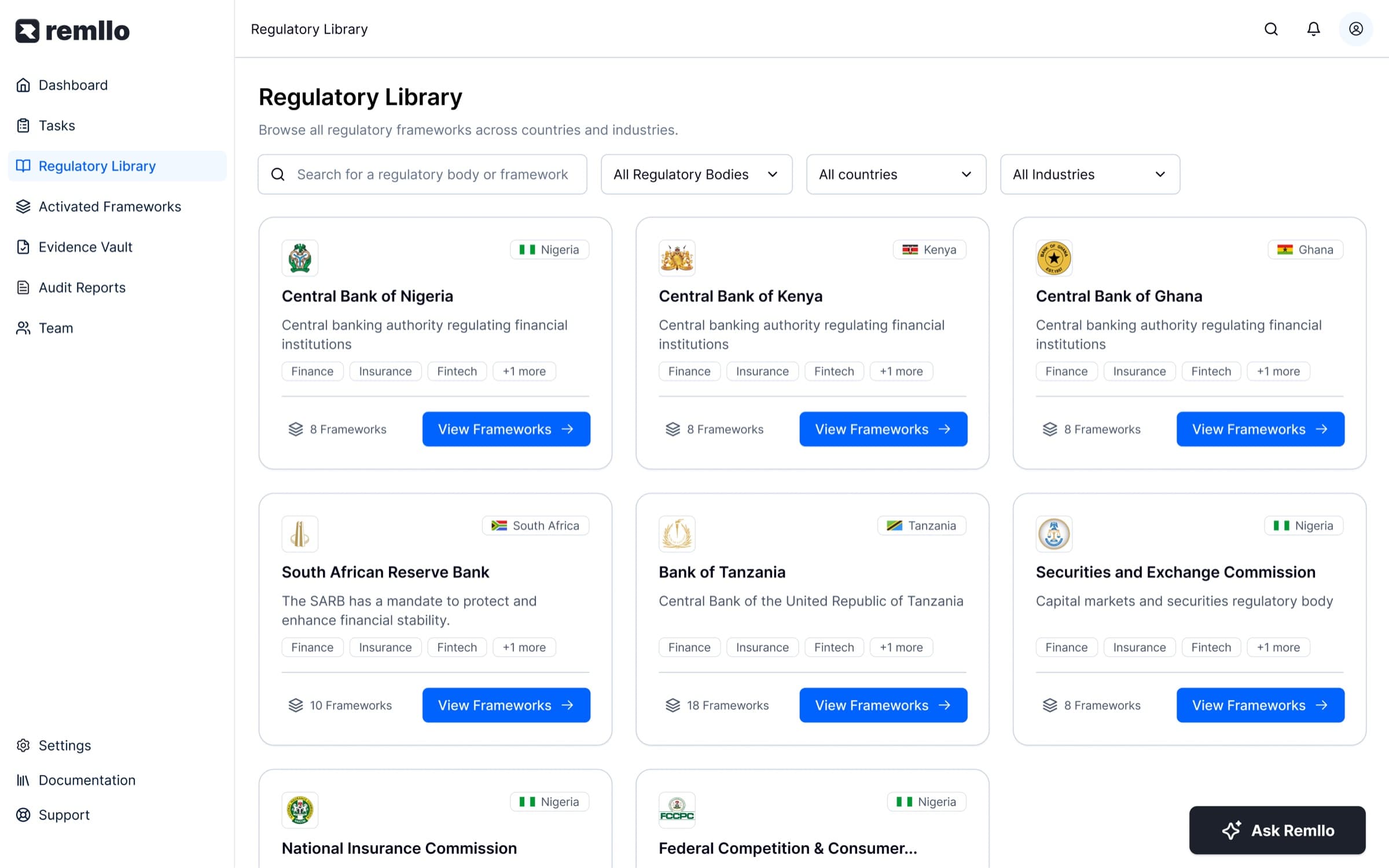
A searchable library that helps teams find regulatory bodies and frameworks across countries and industries.
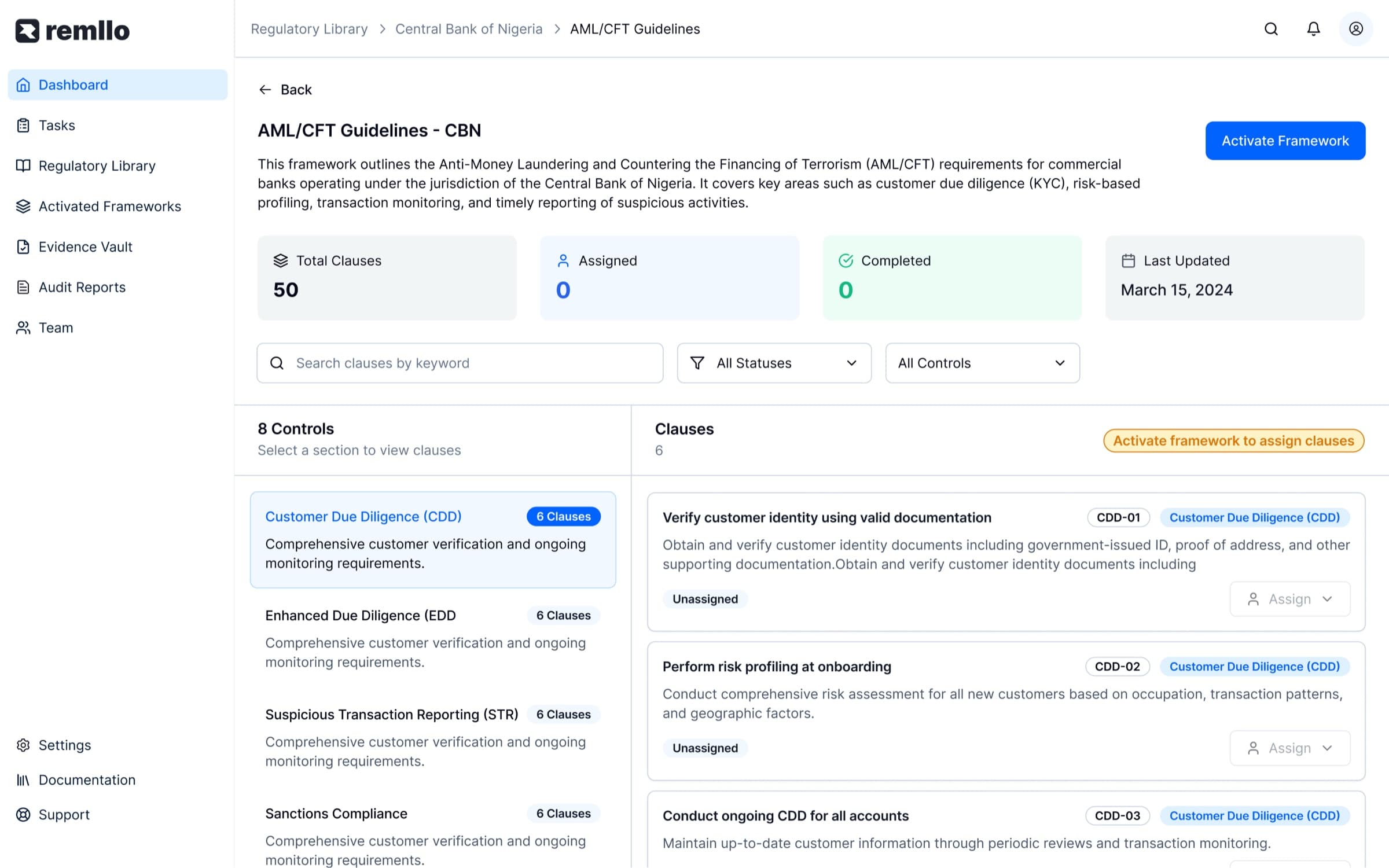
A framework view that turns regulatory clauses into visible, assignable, and traceable work.
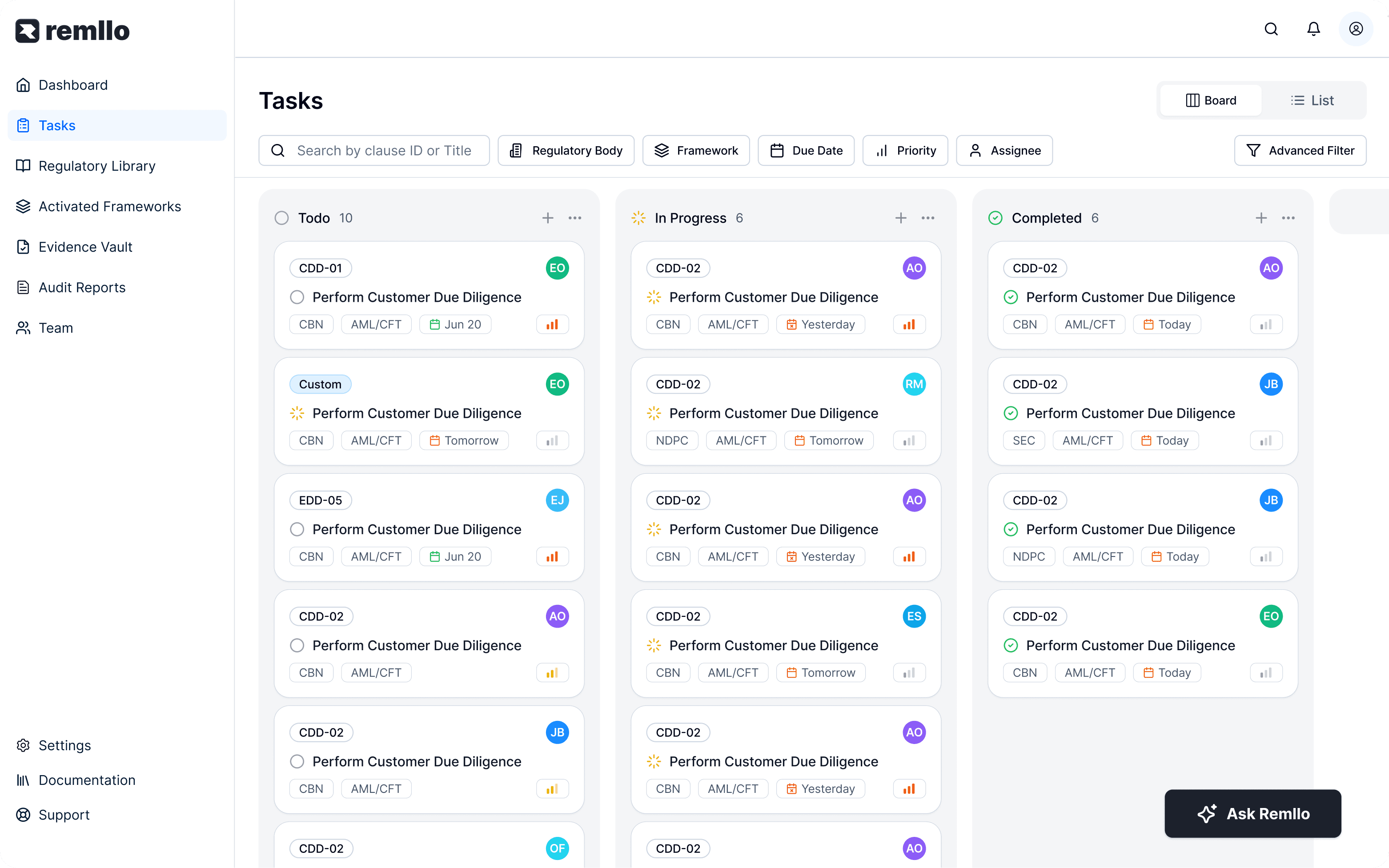
Compliance tasks organized by status, ownership, due date, framework, and priority.
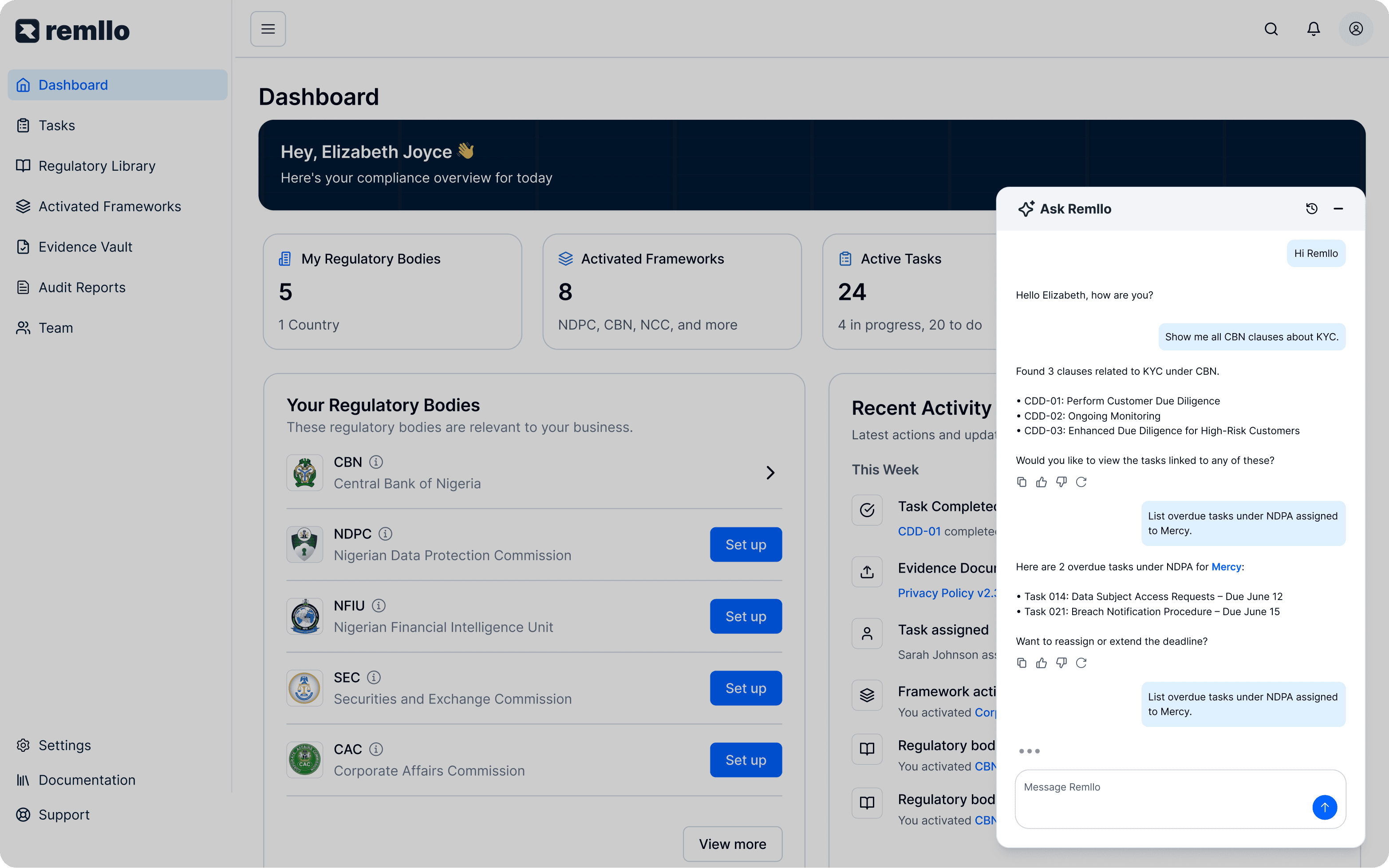
AI assistance that helps teams retrieve and understand compliance information while leaving review and action with the responsible team.
Design approach
Designing for daily clarity and long-term readiness.
The experience was shaped by the need to make compliance useful during everyday operations, not only when an audit approaches.
Make the work visible
Show requirements, ownership, progress, and gaps without overwhelming the user.
Turn requirements into action
Connect regulatory content to tasks, controls, evidence, and accountable owners.
Keep AI reviewable
Present AI support as assistance that teams can inspect, refine, and approve.
Connect evidence to context
Keep supporting records close to the work or requirement they help demonstrate.
Make ownership explicit
Give every important task, review, and request a visible status and responsible person.
Prepare continuously
Help teams maintain records as work happens instead of rebuilding the story later.
Compliance is not one workflow.
The product had to feel intelligent without becoming careless, and structured without becoming burdensome.
- Connected regulations, frameworks, controls, tasks, people, and evidence
- Different levels of context for compliance, operations, leadership, and audit teams
- Traceable activity that shows what happened, who acted, and what supports the current state
- AI assistance that remains visible, reviewable, and accountable
Outcome
A clearer product model for AI-native compliance operations.
The work established a connected product direction for managing frameworks, tasks, controls, evidence, and readiness within the broader Remllo ecosystem. It also clarified how AI could assist with interpretation and organization while keeping judgement and accountability with the team.
- 01A coherent model connecting regulatory requirements to operational work
- 02A shared workspace for visibility, ownership, and progress
- 03A practical direction for AI-assisted compliance workflows
- 04A stronger connection between everyday activity and audit readiness
- 05A clearer public narrative for Remllo's compliance product
- 06A product foundation that complements Remllo Identity and Watchtower
11 · Reflection
Compliance is an operating system, not a folder of documents.
Building Remllo Compliance pushed me to think beyond policy storage. The harder product problem is helping people understand what applies, decide what needs to happen, assign responsibility, collect evidence, and maintain a trustworthy record over time.
As a founder, I had to connect product strategy, design, engineering, AI direction, and the realities of regulated work. The experience reinforced that intelligence alone does not create trust. Teams also need clarity, ownership, evidence, review, and auditability.
AI can help regulated teams move faster, but trust still depends on people being able to understand, review, and own the work.